Buy corradomorricone.eu ?
We are moving the project
corradomorricone.eu .
Are you interested in purchasing the domain
corradomorricone.eu ?
domain@kv-gmbh.de · 0541-91531010
Buy corradomorricone.eu ?
What is a finite automaton?
A finite automaton is a mathematical model used to represent a system that processes input and transitions between different states based on that input. It consists of a set of states, a set of input symbols, a transition function that specifies how the automaton moves from one state to another based on the input, a start state, and a set of accepting states. Finite automata are used in computer science and theoretical computer science to model and analyze the behavior of systems that can be in a finite number of states and transition between them based on input. They are used in various applications such as lexical analysis in compilers, pattern matching in text processing, and modeling of digital circuits. **
How do you create a deterministic finite automaton from a non-deterministic pushdown automaton?
To create a deterministic finite automaton (DFA) from a non-deterministic pushdown automaton (PDA), we can use the subset construction method. This involves creating a state in the DFA for each possible combination of states in the PDA. The transitions in the DFA are determined by simulating the behavior of the PDA on each input symbol. If the PDA can be in multiple states at a given time, the DFA will have a state for each combination of those states. The final states of the DFA are determined by whether any of the PDA's possible states are final states. This process results in a deterministic finite automaton that simulates the behavior of the original non-deterministic pushdown automaton. **


Similar search terms for Automaton
Top-Angebote
Products related to Automaton:
-
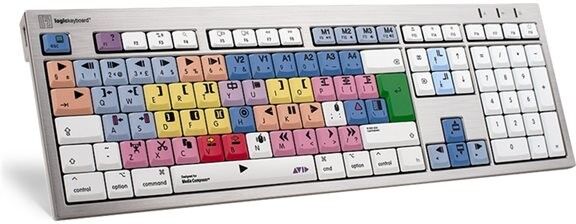
Logic Keyboards Avid Media Composer Slimline UKSpecialized keyboard designed for Avid Media Composer with UK layout and integrated numeric keypad. Wired USB connection includes dual USB 2.0 hubs for peripheral connectivity. Compatible with Windows 7 through Windows 11.138,99 £*Shipping: 0,00 £Secure redirect to the provider
-
Logic Keyboards Avid Media Composer ALBA SilverWired keyboard optimized for Avid Media Composer with 109 keys and integrated USB hub. Features classic Mac layout with UK QWERTY localization and numeric keypad. Slim aluminum construction weighing 840g.136,49 £*Shipping: 0,00 £Secure redirect to the provider
-
Logic Keyboards Media Composer TITAN Keyboard MulticolourHigh-performance keyboard for Avid Media Composer featuring 110 keys with classic layout and customized hot keys for video editing efficiency. Supports wireless (Bluetooth 5.1) and wired USB connections with 5-level backlighting and numeric keypad. Slim profile (43 x 11.9 x 1.3 cm, 580g) with UK QWERTY layout and 1-year warranty.144,49 £*Shipping: 0,00 £Secure redirect to the provider
-
Logic Keyboards Avid Media Composer Astra 2 BlackSpecialized keyboard designed for Avid Media Composer with 109 keys, 5-level backlighting, and integrated USB hub. Features wired connectivity, numeric keypad, and classic layout optimized for Windows editing workflows. QWERTY UK layout.144,49 £*Shipping: 0,00 £Secure redirect to the provider



-
How do you transfer the state transition diagram of an automaton into an automaton table?
To transfer the state transition diagram of an automaton into an automaton table, you need to list all the states of the automaton as rows in the table. Then, list all the input symbols as columns in the table. Fill in the table with the corresponding next state for each combination of current state and input symbol based on the transitions in the state transition diagram. Finally, indicate the initial state and any final states in the table. This table can then be used to simulate the behavior of the automaton for different input sequences. **
-
How do you enter the state transition diagram of an automaton into an automaton table?
To enter the state transition diagram of an automaton into an automaton table, you first list all the states of the automaton as rows in the table. Then, list all the input symbols as columns in the table. For each state and input symbol pair, fill in the corresponding cell with the next state that the automaton transitions to. Repeat this process for all state and input symbol pairs until the entire transition diagram is represented in the automaton table. **
-
How does a non-deterministic finite automaton work?
A non-deterministic finite automaton (NFA) is a theoretical model of computation that consists of a set of states, a set of input symbols, a transition function, an initial state, and a set of accepting states. Unlike a deterministic finite automaton (DFA), an NFA can have multiple possible transitions from a given state on a given input symbol. When processing input, an NFA can be in multiple states simultaneously and can transition to multiple states at once. It accepts a given input string if there exists at least one path through the states that leads to an accepting state. NFAs are often used in theoretical computer science to model certain types of computations and are a key concept in the theory of formal languages and automata. **
-
How does a deterministic finite automaton (DFA) work?
A deterministic finite automaton (DFA) is a mathematical model used to recognize patterns in strings of symbols. It consists of a finite set of states, a finite set of input symbols, a transition function that maps a state and an input symbol to another state, a start state, and a set of accepting states. The DFA starts in the start state and reads input symbols one at a time, transitioning between states according to the transition function. Once the input is fully processed, the DFA is in a final state, and if that state is an accepting state, the input is accepted; otherwise, it is rejected. DFAs are used in various applications, such as lexical analysis in compilers and pattern matching in text processing. **


What is a deterministic finite automaton in computer science?
A deterministic finite automaton (DFA) is a type of finite state machine in computer science. It consists of a set of states, a set of input symbols, a transition function that maps states and input symbols to other states, a start state, and a set of accepting states. DFAs are used to recognize patterns in input strings by transitioning between states based on the input symbols. They are simpler than nondeterministic finite automata (NFAs) as they have a unique transition for each input symbol in each state. **
What is a cellar automaton in theoretical computer science?
A cellar automaton is a type of cellular automaton in theoretical computer science. Cellular automata are discrete models studied in computer science and mathematics, consisting of a grid of cells, each of which can be in a finite number of states. The state of each cell evolves over time according to a set of rules based on the states of neighboring cells. In a cellar automaton, the grid is arranged in a three-dimensional lattice, and the state of each cell is updated based on the states of its six neighboring cells. Cellar automata are used to study complex systems and emergent behavior in various fields, including physics, biology, and computer science. **
Top-Angebote
Products related to Automaton:
-
Dark Souls Trilogy (No Soundtrack) PS4, Used - Good.gadcet-pdp{--g-green:#00a651;color:#1f2430;line-height:1.55;font-size:inherit;max-width:760px}.gadcet-pdp>*:first-child{margin-top:0}.gadcet-pdp p{margin:0 0.9em}.gadcet-pdp h3{font-size:1.05em;font-weight:600;color:#11161f;margin:1.4em 0.5em;padding-left:.5em;border-left:3px solid var(--g-green);border-radius:0;line-height:1.3}.gadcet-pdp ul{list-style:none!important;margin:0 0.9em;padding:0!important}.gadcet-pdp ul li{position:relative;padding:.1em 0.1em 1.5em;margin:0}.gadcet-pdp ul li::before{content:"";position:absolute;left:.16em;top:.45em;width:.36em;height:.66em;border:solid var(--g-green);border-width:0.14em.14em 0;transform:rotate(45deg)}.gadcet-pdp table{width:100%;border-collapse:collapse;margin:.3em 0 1em;font-size:.95em;border:1px solid #e7e9ee!important;border-radius:8px;overflow:hidden}.gadcet-pdp table td{padding:.5em.8em;border-bottom:1px solid #eef0f4!important;vertical-align:top}.gadcet-pdp table tr:last-child td{border-bottom:0!important}.gadcet-pdp table tr:nth-child(even){background:#f7f9f8}.gadcet-pdp table td:first-child{font-weight:600;color:#454c59;width:40%}@media (max-width:600px){.gadcet-pdp table td:first-child{width:42%}} Take on three demanding fantasy action RPG adventures with Dark Souls Trilogy for PlayStation 4. Explore haunting worlds, master tactical combat and face formidable bosses across the complete trilogy. Key Features Includes Dark Souls Remastered, Dark Souls II: Scholar of the First Sin and Dark Souls III: The Fire Fades Edition Strategic real-time combat using weapons, shields, magic and abilities Deep character progression with customisable attributes, equipment and playstyles Interconnected fantasy worlds filled with castles, dungeons, ruins and hidden secrets Online co-operative and competitive multiplayer features New Game Plus modes and multiple character builds for added replay value Games-only edition with no official soundtrack included Benefits Enjoy the full Dark Souls journey in one PS4 collection Rewarding exploration and challenging battles for action RPG fans Choose between New and Used - Good condition options Specifications Platform PlayStation 4 Genre Fantasy action RPG Format Physical game Included games Dark Souls Remastered; Dark Souls II: Scholar of the First Sin; Dark Souls III: The Fire Fades Edition Soundtrack Not included Available conditions New or Used - Good What You'll Receive Dark Souls Trilogy for PlayStation 4 in your selected condition. This is the games-only edition and does not include the official soundtrack. Ideal For Ideal for PlayStation players who enjoy demanding combat, atmospheric fantasy worlds, character progression and exploration-driven action RPGs.42,99 £*Shipping: 0,00 £Secure redirect to the provider
-
RCR Crystal - Orchestra Glassware Set Clear 290mlAdd stunning Italian style and sophistication to your home bar or restaurant with this 24 24-piece orchestra Glassware Set from RCR Crystal. Since 1967 RCR Crystal has dedicated itself to the pursuit of cutting-edge, high-performance glassware, all produced from the company's headquarters in the heart of Tuscany. The Orchestra range stands as a testament to the brand's philosophy and heritage, with a beautiful cut glass decoration that lends a vintage, art deco-inspired aesthetic to any dining table. Each piece in this collection has been crafted from RCR's special Luxion® glass - an eco-friendly material that boasts exceptional clarity and shine, high resistance to shock and impact, and perfect acoustics. Luxion® has also been tested for over 4,000 washes in professional dishwashers without even a hint of clouding, so you can be confident that these glasses will stand as a sparkling centerpiece in your glassware collection for years to come! This set comprises 6 Wine Glasses, 6 Champagne Flutes, 6 Highball Glasses, and 6 Whiskey Glasses - your complete drinking glassware collection! RCR91,99 £*Shipping: 0,00 £Secure redirect to the provider
-
Logic Keyboards Avid Media Composer Slimline UKSpecialized keyboard designed for Avid Media Composer with UK layout and integrated numeric keypad. Wired USB connection includes dual USB 2.0 hubs for peripheral connectivity. Compatible with Windows 7 through Windows 11.138,99 £*Shipping: 0,00 £Secure redirect to the provider
-
Logic Keyboards Avid Media Composer ALBA SilverWired keyboard optimized for Avid Media Composer with 109 keys and integrated USB hub. Features classic Mac layout with UK QWERTY localization and numeric keypad. Slim aluminum construction weighing 840g.136,49 £*Shipping: 0,00 £Secure redirect to the provider
-
What is a finite automaton?
A finite automaton is a mathematical model used to represent a system that processes input and transitions between different states based on that input. It consists of a set of states, a set of input symbols, a transition function that specifies how the automaton moves from one state to another based on the input, a start state, and a set of accepting states. Finite automata are used in computer science and theoretical computer science to model and analyze the behavior of systems that can be in a finite number of states and transition between them based on input. They are used in various applications such as lexical analysis in compilers, pattern matching in text processing, and modeling of digital circuits. **
-
How do you create a deterministic finite automaton from a non-deterministic pushdown automaton?
To create a deterministic finite automaton (DFA) from a non-deterministic pushdown automaton (PDA), we can use the subset construction method. This involves creating a state in the DFA for each possible combination of states in the PDA. The transitions in the DFA are determined by simulating the behavior of the PDA on each input symbol. If the PDA can be in multiple states at a given time, the DFA will have a state for each combination of those states. The final states of the DFA are determined by whether any of the PDA's possible states are final states. This process results in a deterministic finite automaton that simulates the behavior of the original non-deterministic pushdown automaton. **
-
How do you transfer the state transition diagram of an automaton into an automaton table?
To transfer the state transition diagram of an automaton into an automaton table, you need to list all the states of the automaton as rows in the table. Then, list all the input symbols as columns in the table. Fill in the table with the corresponding next state for each combination of current state and input symbol based on the transitions in the state transition diagram. Finally, indicate the initial state and any final states in the table. This table can then be used to simulate the behavior of the automaton for different input sequences. **
-
How do you enter the state transition diagram of an automaton into an automaton table?
To enter the state transition diagram of an automaton into an automaton table, you first list all the states of the automaton as rows in the table. Then, list all the input symbols as columns in the table. For each state and input symbol pair, fill in the corresponding cell with the next state that the automaton transitions to. Repeat this process for all state and input symbol pairs until the entire transition diagram is represented in the automaton table. **
Similar search terms for Automaton
-
Logic Keyboards Media Composer TITAN Keyboard MulticolourHigh-performance keyboard for Avid Media Composer featuring 110 keys with classic layout and customized hot keys for video editing efficiency. Supports wireless (Bluetooth 5.1) and wired USB connections with 5-level backlighting and numeric keypad. Slim profile (43 x 11.9 x 1.3 cm, 580g) with UK QWERTY layout and 1-year warranty.144,49 £*Shipping: 0,00 £Secure redirect to the provider
-
Logic Keyboards Avid Media Composer Astra 2 BlackSpecialized keyboard designed for Avid Media Composer with 109 keys, 5-level backlighting, and integrated USB hub. Features wired connectivity, numeric keypad, and classic layout optimized for Windows editing workflows. QWERTY UK layout.144,49 £*Shipping: 0,00 £Secure redirect to the provider
-
Logic Keyboards Media Composer ASTRA 2 Keyboard MulticolourClassic layout keyboard for Avid Media Composer featuring 109 keys with 5-level backlighting and integrated USB hub for additional connectivity. Wired USB connection with multimedia hot keys and numeric keypad optimized for Mac-based video editing. Larger footprint (44.6 x 15 x 3 cm, 950g) provides ergonomic layout for professional workflows.144,49 £*Shipping: 0,00 £Secure redirect to the provider
-
Logic Keyboards Media Composer ASTRA 2 Keyboard BlackProfessional keyboard for Media Composer on Windows platforms with 109 keys in pro layout and 5-level backlighting. Wired USB connection with integrated USB hub and numeric keypad for efficient editing control. Robust construction (44.6 x 15 x 3 cm, 950g) with 1-year manufacturer warranty.144,49 £*Shipping: 0,00 £Secure redirect to the provider
-
How does a non-deterministic finite automaton work?
A non-deterministic finite automaton (NFA) is a theoretical model of computation that consists of a set of states, a set of input symbols, a transition function, an initial state, and a set of accepting states. Unlike a deterministic finite automaton (DFA), an NFA can have multiple possible transitions from a given state on a given input symbol. When processing input, an NFA can be in multiple states simultaneously and can transition to multiple states at once. It accepts a given input string if there exists at least one path through the states that leads to an accepting state. NFAs are often used in theoretical computer science to model certain types of computations and are a key concept in the theory of formal languages and automata. **
-
How does a deterministic finite automaton (DFA) work?
A deterministic finite automaton (DFA) is a mathematical model used to recognize patterns in strings of symbols. It consists of a finite set of states, a finite set of input symbols, a transition function that maps a state and an input symbol to another state, a start state, and a set of accepting states. The DFA starts in the start state and reads input symbols one at a time, transitioning between states according to the transition function. Once the input is fully processed, the DFA is in a final state, and if that state is an accepting state, the input is accepted; otherwise, it is rejected. DFAs are used in various applications, such as lexical analysis in compilers and pattern matching in text processing. **
-
What is a deterministic finite automaton in computer science?
A deterministic finite automaton (DFA) is a type of finite state machine in computer science. It consists of a set of states, a set of input symbols, a transition function that maps states and input symbols to other states, a start state, and a set of accepting states. DFAs are used to recognize patterns in input strings by transitioning between states based on the input symbols. They are simpler than nondeterministic finite automata (NFAs) as they have a unique transition for each input symbol in each state. **
-
What is a cellar automaton in theoretical computer science?
A cellar automaton is a type of cellular automaton in theoretical computer science. Cellular automata are discrete models studied in computer science and mathematics, consisting of a grid of cells, each of which can be in a finite number of states. The state of each cell evolves over time according to a set of rules based on the states of neighboring cells. In a cellar automaton, the grid is arranged in a three-dimensional lattice, and the state of each cell is updated based on the states of its six neighboring cells. Cellar automata are used to study complex systems and emergent behavior in various fields, including physics, biology, and computer science. **
* All prices are inclusive of VAT and, if applicable, plus shipping costs. The offer information is based on the details provided by the respective shop and is updated through automated processes. Real-time updates do not occur, so deviations can occur in individual cases. ** Note: Parts of this content were created by AI.